

May Marks the Moment: Whale Watching Season Comes Alive

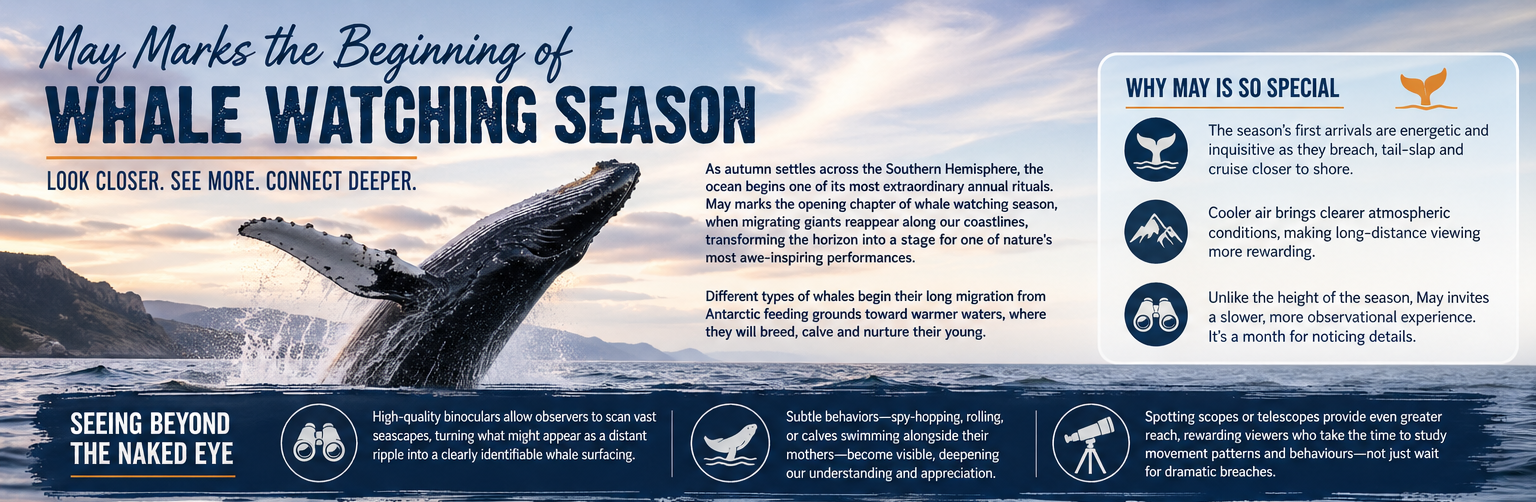
As autumn settles across the Southern Hemisphere, the ocean begins one of its most extraordinary annual rituals. May marks the opening chapter of whale watching season, when migrating giants reappear along our coastlines, transforming the horizon into a stage for one of nature's most awe-inspiring performances.
For marine biologists, outdoor enthusiasts and curious observers alike, this is a time of renewed attention to the sea. Different types of whales begin their long migration from Antarctic feeding grounds toward warmer waters, where they will breed, calve and nuture their young.
Why May Is So Special
While peak whale watching often stretches into winter, May holds a distinct appeal. The season’s first arrivals tend to be energetic and inquisitive as they breach, tail-slap and cruise closer to shore as they navigate familiar migratory routes. Cooler air also brings clearer atmospheric conditions, making long-distance viewing more rewarding for those equipped with quality optics.
Unlike the height of the season, May invites a slower, more observational experience. It’s a month for noticing details.
Seeing Beyond the Naked Eye
Whales are immense, but the ocean is larger still. This is where optics quietly elevate the experience.
High-quality binoculars allow observers to scan vast seascapes, turning what might appear as a distant ripple into a clearly identifiable whale surfacing. Subtle behaviors where the whales are spy-hopping, rolling or calves swimming alongside their mothers become visible, deepening our understanding as well as appreciation.
For those watching from headlands or coastal lookouts, spotting scopes or telescopes provide even greater reach. They invite patience and precision, rewarding viewers who take the time to study movement patterns and behaviours rather than waiting for dramatic breaches alone.
Choosing the Right Optics for Whale Watching
Selecting the correct optical equipment can transform an impressive view into an unforgettable encounter.
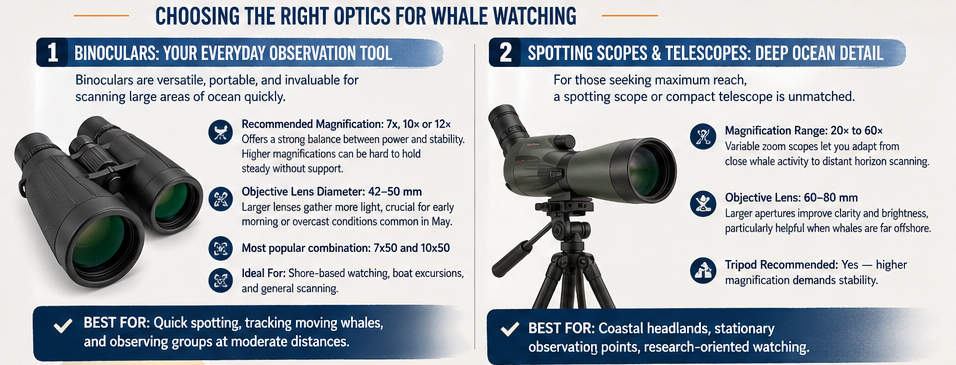
1. Binoculars: Your Everyday Observation Tool
Binoculars are versatile, portable, and invaluable for scanning large areas of ocean quickly.
- Recommended Magnification: 7x, 10× or 12×
Offers a strong balance between power and stability. Higher magnifications can be hard to hold steady without support.
- Objective Lens Diameter: 42–50 mm
Larger lenses gather more light, crucial for early morning or overcast conditions common in May.
- Most popular combination would be: 7x50 and 10x50
- Ideal For: Shore-based watching, boat excursions, and general scanning.
✔ Best for: Quick spotting, tracking moving whales, and observing groups at moderate distances.
2. Spotting Scopes & Telescopes: Deep Ocean Detail
For those seeking maximum reach, a spotting scope or compact telescope is unmatched.
- Magnification Range: 20× to 60×
Variable zoom scopes let you adapt from close whale activity to distant horizon scanning. - Objective Lens: 60–80 mm
Larger apertures improve clarity and brightness, particularly helpful when whales are far offshore. - Tripod Recommended: Yes — higher magnification demands stability.
✔ Best for: Coastal headlands, stationary observation points, research-oriented watching.
Making the Most of the Season
To fully appreciate whale watching in May:
- Choose elevated viewpoints such as cliffs, headlands, or coastal trails.
- Observe patiently: whales often surface rhythmically, and stillness pays off.
- Use optics responsibly, avoiding disturbance while enhancing clarity.
- Record observations, whether through photography, note-taking, or sketches.
These practices not only enrich the experience but foster a more thoughtful connection with the environment.
Ethical and practical notes
- Keep a respectful distance: whale-watching guidelines emphasize minimizing disturbance. Your optics should help you observe without approaching closer than locally permitted.
- Check local regulations: seasons, speed limits for boats, and restricted viewing zones can change. Always align your plans with current rules so your observations remain responsible and reproducible.
- Be mindful of the light: late May afternoons can have striking golden-hour light. A polarizing filter on a binocular or scope can reduce glare, improve contrast, and protect your eyes during long viewing sessions.
At its core, whale watching is about perspective. It reminds us that the world is vast, dynamic, and layered with stories unfolding beyond immediate view. Optical tools whether binoculars, spotting scopes, or microscopes extend human vision, allowing us to engage more deeply with those stories.
As May ushers in whale watching season, it invites us to slow down, look closer, and appreciate the extraordinary within the natural world. Sometimes, all it takes is a clear lens and a bit of curiosity to witness something unforgettable.