

A Rare Night Sky Treat: The Upcoming Blue Moon & Micro Moon
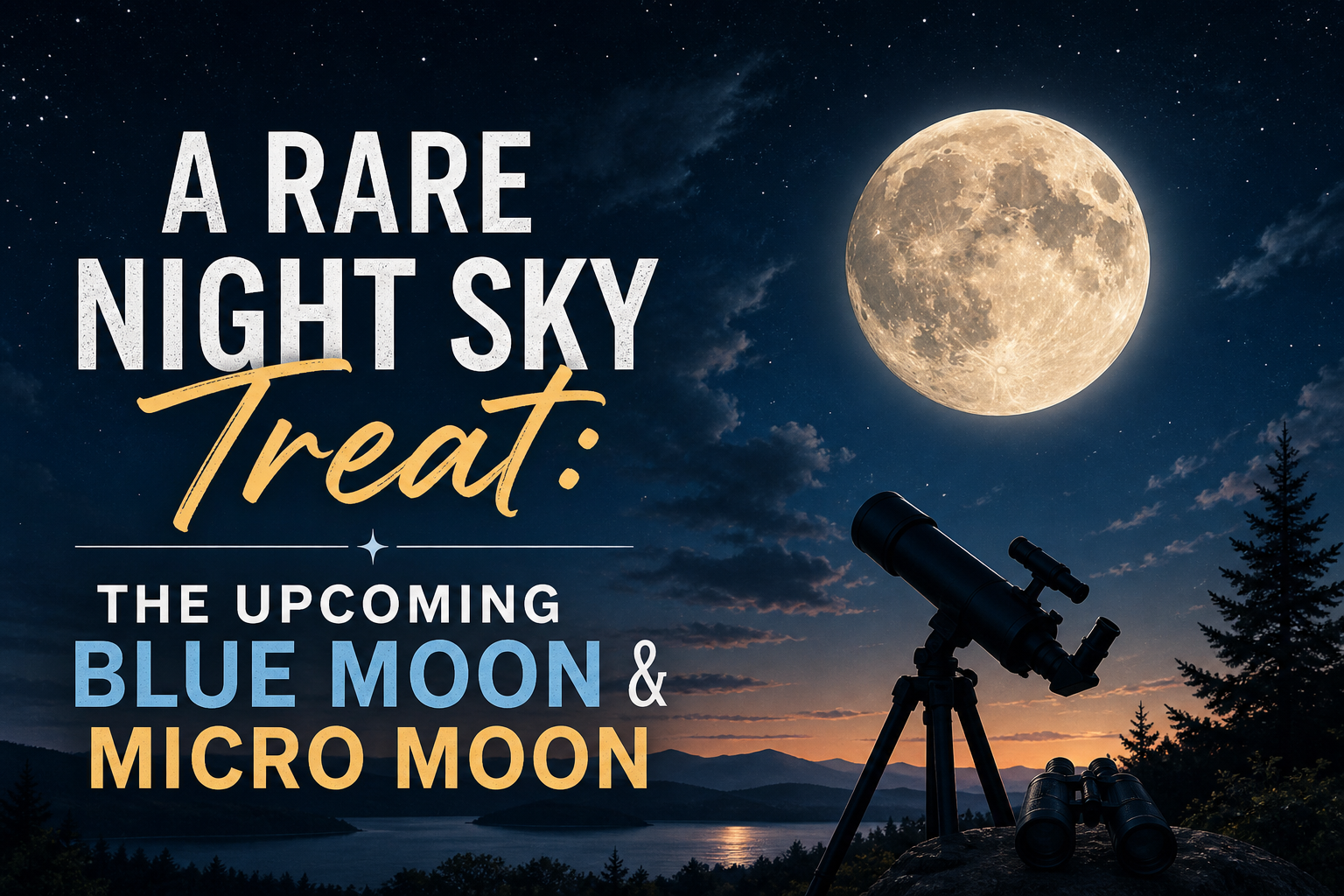
There’s something quietly magical about looking up at the night sky and realizing you’re witnessing an event that doesn’t come around often. On May 31, 2026, we’ll witness a rare pairing: a Blue Moon that also happens to be a Micro Moon. It’s not the flashiest celestial event, but that’s part of its charm and it rewards those who take a moment to look a little closer.
A “Blue Moon” That Isn’t Blue
Let’s clear up the biggest misconception first: the Moon won’t actually turn blue.
A Blue Moon is simply the second full moon within a single calendar month. Because the lunar cycle takes about 29.5 days, this alignment only happens every couple of years.
That’s also where the phrase “once in a blue moon” comes from meaning something that doesn’t happen often.
While rare atmospheric conditions (like volcanic eruptions) can tint the Moon blue, that’s not what’s happening here. This Blue Moon is “blue” in name only.
Why This One Is a Micro Moon
What makes this particular full moon more interesting is that it’s also a Micro Moon.
A Micro Moon occurs when the full moon happens near apogee—the point where the Moon is farthest from Earth in its slightly elliptical orbit.
Here’s what that means for observers:
- The Moon appears slightly smaller than usual
- It may look a little dimmer than an average full moon
- It’s around 6–7% smaller than a typical full moon, and noticeably smaller compared to a supermoon.
In fact, this will be one of the smallest full moons of 2026.
What to Expect in the Sky
At a glance, you might not immediately notice the difference. The Moon will still look full, bright and familiar. But that’s part of the experience, this is a subtle astronomical event.
If you watch closely especially over multiple months you may start to notice:
- A slightly reduced size compared to previous full moons
- Softer brightness, particularly when higher in the sky
- Warmer hues (orange or yellow) during moonrise due to Earth’s atmosphere
Interestingly, when the Moon sits near the horizon it can actually appear larger due to the Moon illusion, a trick of human perception rather than a real size change.
A Perfect Moment to Slow Down and Observe
Events like this aren’t about dramatic transformations, they’re about perspective.
The Blue Micro Moon is a reminder that even familiar sights like the full moon are constantly changing in ways we don’t always notice. It invites a different kind of observation: slower, more intentional and a bit more curious.
For casual stargazers, it’s a great excuse to step outside at dusk. For enthusiasts, it’s an opportunity to compare, photograph and appreciate the Moon’s shifting scale throughout the year.
Enhancing the View (Without Overcomplicating It)
While the Micro Moon doesn’t demand equipment, using optics can transform the experience:
- Binoculars can reveal lunar maria (the darker plains) and subtle surface contrasts
Recommendations:
- GPO Passion HD 10x50 Binoculars
- GOVIEW ZOOMR 10x42 Binoculars
- Celestron Nature DX 10x42 Binoculars
- GPO Passion ED 8x56 Binoculars
- saxon 20x80 Night Sky Waterproof Binoculars
- Telescopes bring out craters, ridges, and fine textures—even when the Moon appears smaller
Recommendations:
- Celestron StarSense Explorer LT127AZ Reflector Telescope
- saxon 1141EQ Reflector Telescope with Motor Drive
- Celestron NexStar 6SE Computerised Schmidt-Cassegrain Telescope
- saxon 10” DeepSky Dobsonian Telescope
- saxon 909AZ3 Refractor Telescope
Because the Moon is slightly farther away, details may feel just a touch less prominent but that challenge is part of the fun for observers and photographers alike.
So on May 31, take a moment. Look up.
You’ll be seeing something that truly happens only once in a blue moon.